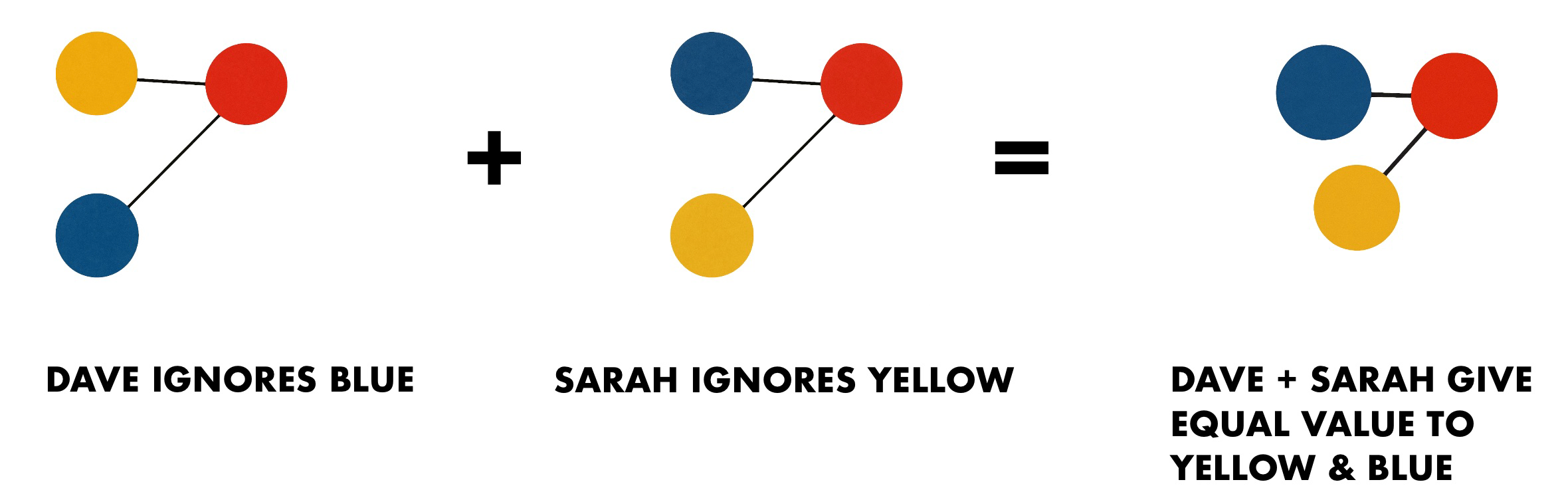
Looking at this picture, a long line represents a weak association between two pieces of information. A short line represents a strong association.
Now, imagine millions of pieces of information with long lines and short lines. This is how we hold information in our heads and, in a simplistic way, how AI systems store their data.
Cognitive miser theory means that as humans, we work out an answer to a problem by going down the short lines, the most obvious answer. The first answer AI gives you does exactly the same thing.
Think about word association; brains will naturally leap to the most obvious word; it saves calories. Your level of intelligence has no impact on the outcome.
Through my research, autistic individuals can be slower to answer questions because their brains are processing much more information than anyone else’s. In an autistic brain, imagine all that information, but all the lines are the same length. Everything has a short line. So, an autist needs to evaluate every piece of information to consciously decide if it has value in terms of the problem being solved.
This is where the name and concept of Equal Value Thinking came from.
From the picture, you can see Dave thinks about the problem differently to Sarah, but together they don’t miss anything. Together, they can give equal value to all the available information just like an autist. Teams beat individuals; even autistic people will miss things, so teams of diverse thinkers is what is required. In fact, it is essential for solving complex problems.